Assignment Details for: August 31 and Class notes from August 24
 |
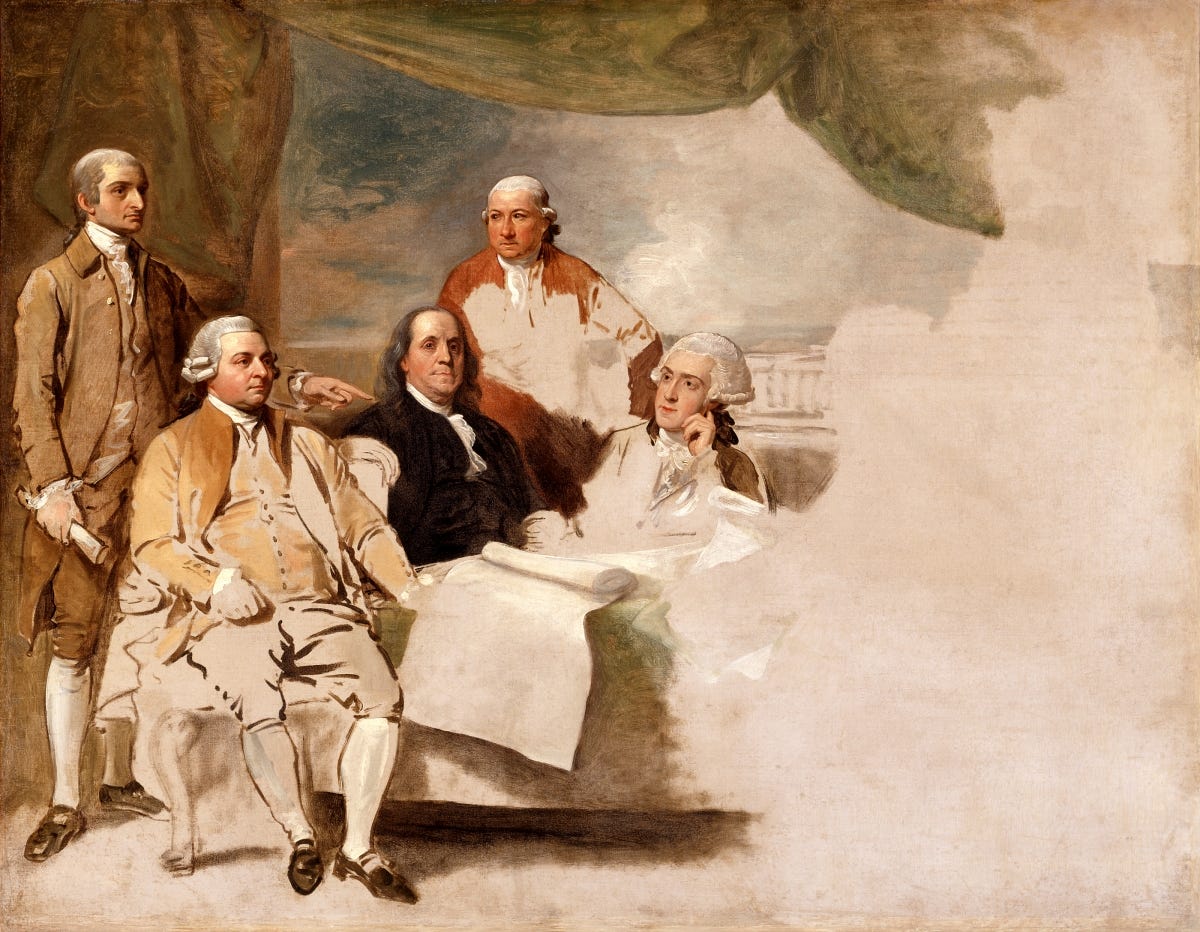
| Benjamin West, Benjamin Franklin Drawing electricity from the Sky,1816, 13"x10" |
What sort of heroic qualities would Benjamin West paint onto you? (Just a rhethorical question!)
Complete the following 3-part Journaling and 1-part reading Assignment before class Tuesday August 31.
Journaling, part 1: Reflecting back on Benjamin Franklin's extremely ambitious and somewhat tongue-in-cheek goal of achieving moral perfection based on 13 virtues, name two “Virtues with their precepts” (precepts= definition of the moral goal)that you would like to perfect– you can choose two of Franklin’s or name your own two. Study Franklin’s day plan. Make your own day plan– whether for next week, or for the plan that you hope you’ll be living in 2031 or 2036– or take a slightly ironic approach and create an overly-ambitious schedule.
Journal, Part 2: if you have additional reflections on Dr. Martin Luther King, Jr's Blueprint Graduation speech, add those in.
Here's the blog post where I embedded the speech.
Next week, we stick with the Old Guys, so the reading is a little difficult, but it's also short.
READ excerpts below from Henry David Thoreau, Walden, or, Life in the Woods, from 1864.
Journal, Part 3: write down 2 points from the passage that make you think. Record your thoughts.

Selections from Walden, or, Life in the Woods, 1864 by essayist, poet, philosopher, naturalist and proto-environmentalist Henry David Thoreau (b.1817-d.1864).
The excerpts are from chapters 1 and 2, "Economy" and "Where I lived, and What I lived for."
If you'd like more, the full text is available at Project Gutenberg.
Also, if you're interested, here's a Marginalian about Thoreau and resolutions.

1. “When I wrote the following pages, or rather the bulk of them, I lived alone, in the woods, a mile from any neighbor, in a house which I had built myself, on the shore of Walden Pond, in Concord, Massachusetts, and earned my living by the labor of my hands only.” (p. 1)

2.“I see young men, my townsmen, whose misfortune it is to have inherited farms, houses, barns, cattle, and farming tools; for these are more easily acquired than got rid of. Better if they had been born in the open pasture and suckled by a wolf, that they might have seen with clearer eyes what field they were called to labor in.” (p. 2)
3. “Most men, even in this comparatively free country, through mere ignorance and mistake, are so occupied with the factitious cares and superfluously coarse labors of life that its finer fruits cannot be plucked by them.” (p. 2) “
4. "The mass of men lead lives of quiet desperation. What is called resignation is confirmed desperation. From the desperate city you go into the desperate country, and have to console yourself with the bravery of minks and muskrats. A stereotyped but unconscious despair is concealed even under what are called the games and amusements of mankind. There is no play in them, for this comes after work. But it is a characteristic of wisdom not to do desperate things. (p. 3)
5. “The necessaries of life for man in this climate may, accurately enough, be distributed under the several heads of Food, Shelter, Clothing, and Fuel; for not till we have secured these are we prepared to entertain the true problems of life with freedom and a prospect of success.” (p. 6)
6. “Most of the luxuries, and many of the so-called comforts of life, are not only not indispensable, but positive hindrances to the elevation of mankind.” (p. 7)
7. “When (we have) obtained those things which are necessary to life, there is another alternative than to obtain the superfluities; and that is, to adventure on life now.” (p. 7)
8. “I do not speak to those who are well employed, in whatever circumstances, and they know whether they are well employed or not;—but mainly to the mass of men who are discontented, and idly complaining of the hardness of their lot or of the times, when they might improve them. There are some who complain most energetically and inconsolably of any, because they are, as they say, doing their duty. I also have in my mind that seemingly wealthy, but most terribly impoverished class of all, who have accumulated dross, but know not how to use it, or get rid of it, and thus have forged their own golden or silver fetters. ” (p. 8)
9. “The cost of a thing is the amount of what I will call life which is required to be exchanged for it, immediately or in the long run.” (p. 15)
10. “Men have become the tools of their tools. The man who independently plucked the fruits when he was hungry is become a farmer; and he who stood under a tree for shelter, a housekeeper. We now no longer camp as for a night, but have settled down on earth and forgotten heaven.” (p. 19)

11. (Thoreau, describing building his own house:) “It was a pleasant hillside where I worked, covered with pine woods, through which I looked out on the pond, and a small open field in the woods where pines and hickories were springing up.” ( p. 20)
12. “There is some of the same fitness in a man’s building his own house that there is in a bird’s building its own nest. Who knows but if men constructed their dwellings with their own hands, and provided food for themselves and families simply and honestly enough, the poetic faculty would be universally developed, as birds universally sing when they are so engaged?” (p. 23 )
13. “I learned from my two years’ experience that it would cost incredibly little trouble to obtain one’s necessary food, even in this latitude; that a man may use as simple a diet as the animals, and yet retain health and strength.” (p. 32)
14. We must learn to reawaken and keep ourselves awake, not by mechanical aids, but by an infinite expectation of the dawn, which does not forsake us in our soundest sleep. I know of no more encouraging fact than the unquestionable ability of man to elevate his life by a conscious endeavor. It is something to be able to paint a particular picture, or to carve a statue, and so to make a few objects beautiful; but it is far more glorious to carve and paint the very atmosphere and medium through which we look, which morally we can do. To affect the quality of the day, that is the highest of arts. Every man is tasked to make his life, even in its details, worthy of the contemplation of his most elevated and critical hour. If we refused, or rather used up, such paltry information as we get, the oracles would distinctly inform us how this might be done.
15. “ I went to the woods because I wished to live deliberately, to front only the essential facts of life, and see if I could not learn what it had to teach, and not, when I came to die, discover that I had not lived. I did not wish to live what was not life, living is so dear; nor did I wish to practise resignation, unless it was quite necessary. I wanted to live deep and suck out all the marrow of life, to live so sturdily and Spartan-like as to put to rout all that was not life, to cut a broad swath and shave close, to drive life into a corner, and reduce it to its lowest terms, and, if it proved to be mean, why then to get the whole and genuine meanness of it, and publish its meanness to the world; or if it were sublime, to know it by experience, and be able to give a true account of it in my next excursion. ” (p. 48)
16. Still we live meanly, like ants; though the fable tells us that we were long ago changed into men; like pygmies we fight with cranes; it is error upon error, and clout upon clout, and our best virtue has for its occasion a superfluous and evitable wretchedness. Our life is frittered away by detail. An honest man has hardly need to count more than his ten fingers, or in extreme cases he may add his ten toes, and lump the rest. Simplicity, simplicity, simplicity! I say, let your affairs be as two or three, and not a hundred or a thousand; instead of a million count half a dozen, and keep your accounts on your thumb nail. In the midst of this chopping sea of civilized life, such are the clouds and storms and quicksands and thousand-and-one items to be allowed for, that a man has to live, if he would not founder and go to the bottom and not make his port at all, by dead reckoning, and he must be a great calculator indeed who succeeds. Simplify, simplify. Instead of three meals a day, if it be necessary eat but one; instead of a hundred dishes, five; and reduce other things in proportion [ . . . ] The nation itself, with all its so called internal improvements, which, by the way are all external and superficial, is just such an unwieldy and overgrown establishment, cluttered with furniture and tripped up by its own traps, ruined by luxury and heedless expense, by want of calculation and a worthy aim, as the million households in the land; and the only cure for it as for them is in a rigid economy, a stern and more than Spartan simplicity of life and elevation of purpose. It lives too fast. Men think that it is essential that the Nation have commerce, and export ice, and talk through a telegraph, and ride thirty miles an hour, without a doubt, whether they do or not; but whether we should live like baboons or like men, is a little uncertain. If we do not get out sleepers, and forge rails, and devote days and nights to the work, but go to tinkering upon our lives to improve them, who will build railroads? And if railroads are not built, how shall we get to heaven in season? But if we stay at home and mind our business, who will want railroads? We do not ride on the railroad; it rides upon us. ” (p. 48)
To repeat, Journal, Part 3: write down 2 points from the passage that make you think. Record your thoughts.

CLASS NOTES about GOALS-- is there anything we should add?
What would you like to have learned by Dec. 15th? Practical answers and more philosophical answers welcome:
Figure out what will actually fulfill me– so many things I could do with my degree but what at the core will make me happy be the blueprint
Finding more intention in everything I do
I want to know what to do next? What can i do as an artist
Is it bad to say “I don’t know?” what does that mean to mean as a grad
Hoping to have more concrete idea of how to be confident in living life as an artist. Some semblance o f a plan
Keeping an open mind to the unexpected of being an artist (so hard to predict thefuture{
Figuring out what’s important to you and what to prioritixe in your daily life and future’
Ability to build structure and rebound from change when things don’t go according to plan
I want to learn how to make a career with the art that I’m making rather than learning how to make better art?
1st draft: Shiftquests= you'll name your 6-week shift in class August 31
Time in the studio
Set aside time to Call family every week
Do more daily positive affirmations
Journaling every morning and night –getting more into my brain when alone
Doing pt exercises every other day
Only drink water and drink enough each day
Practice being upside down 3x /week
Making my bed in the morning and reading at night
Stick with the crazy wedding exercise and diet plan
Eat breakfast every morning
Write a letter a week and mail it
Go to the gym more often
Run 5x/week
Work out plan to achieve small goals through the week rather than getting overwhelmed by whole project
Spend more time relaxing
Bi-weekly schedule that I adhere to…. Dedicate time to all that needs to happen- including time off
Read books; run more
Be more aware in classes rather than just waiting to get to the next thing– this can help prevent burnout
Read 30 mins a day– or do something outside acting 30 mins/day
Read & be outside for reading